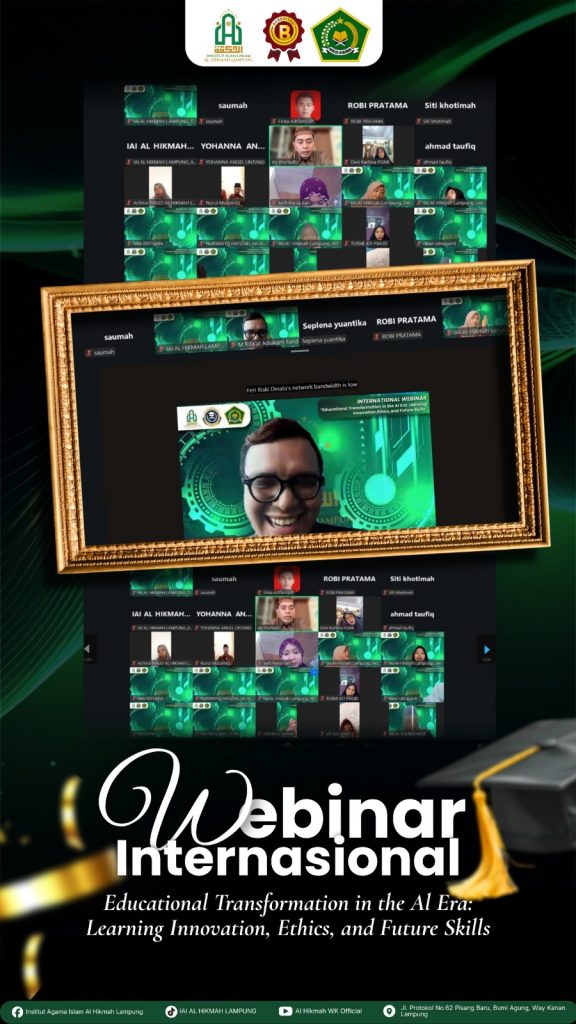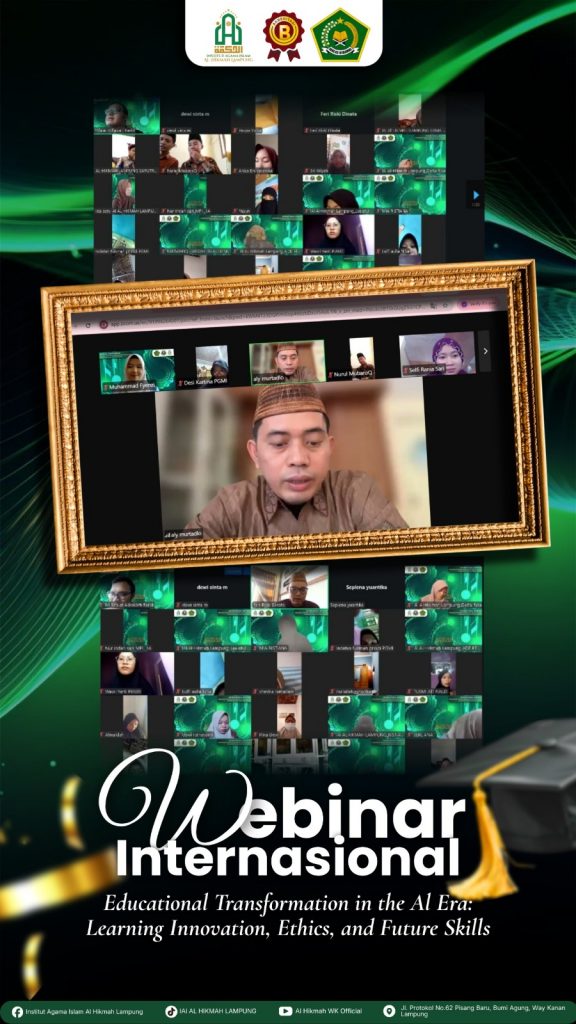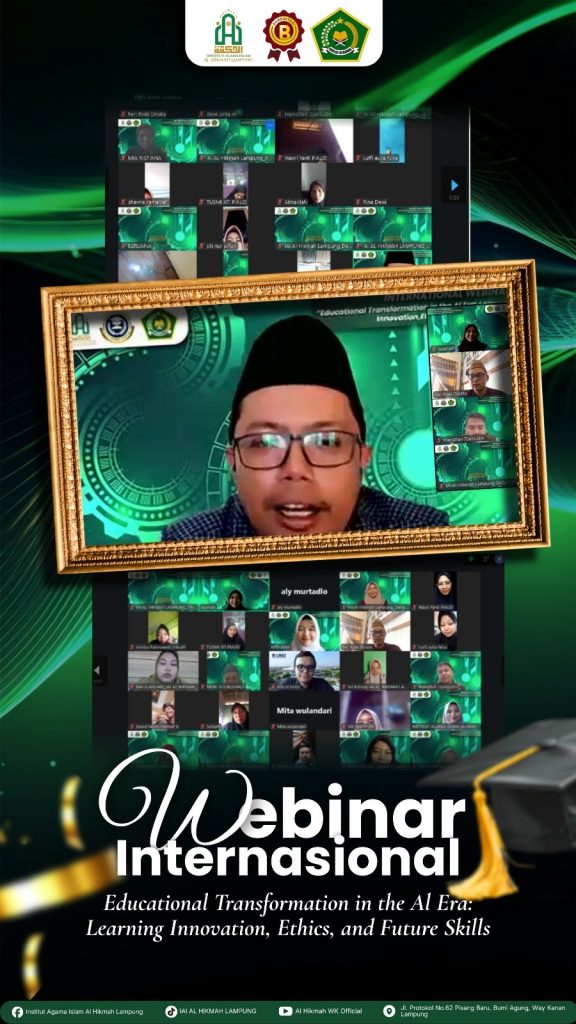
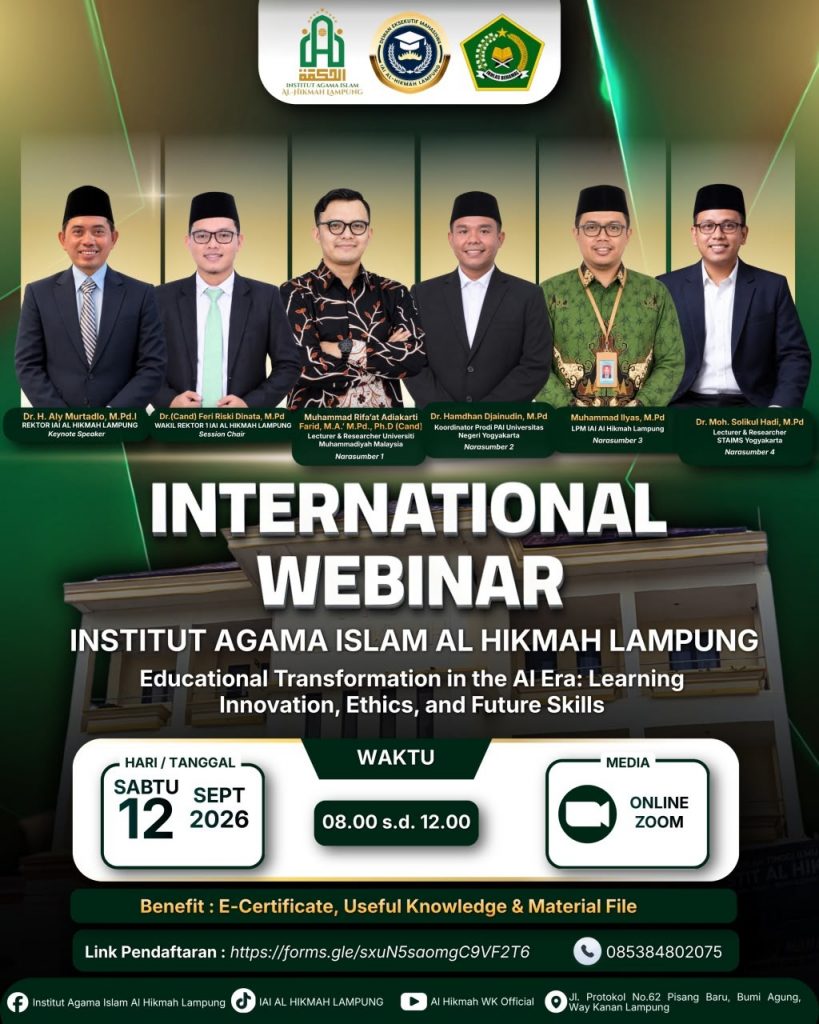
Yogyakarta, September 12, 2026 — Dr. Moh. Solikul Hadi, M.Pd., a lecturer at STAI Masjid Syuhada Yogyakarta, participated as one of the speakers in an International Webinar organized by Institut Agama Islam (IAI) Al Hikmah Lampung on Saturday, September 12, 2026.
The international academic forum was held online via Zoom under the theme “Educational Transformation in the AI Era: Learning Innovation, Ethics, and Future Skills.” The event brought together academics and education practitioners to discuss the changing landscape of education in response to the rapid development of Artificial Intelligence (AI).
Dr. Moh. Solikul Hadi, M.Pd. participated as Speaker 4, alongside several other academics and education leaders. The webinar featured Dr. H. Aly Murtado, M.Pd.I., Rector of IAI Al Hikmah Lampung, as the keynote speaker, together with Dr. (Cand.) Feri Riski Dinata, M.Pd.; Muhammad Rifa’at Adi Kartika Farid, M.A., M.Pd., Ph.D. (Cand.); Dr. Hamdhan Djainudin, M.Pd.; and Muhammad Ilyas, M.Pd.
Educational Transformation in the AI Era In his presentation, Dr. Moh. Solikul Hadi discussed the importance of transforming education in response to the changing learning environment in the era of Artificial Intelligence. He highlighted that information is now available everywhere, while students are increasingly expected not only to understand information but also to create and critically evaluate knowledge. He described the transformation from the Library Era, to the Google Era, and now the AI Learning Era. In this new learning environment, students are no longer simply recipients of information but are increasingly becoming producers of knowledge. The main challenge is therefore not only finding information, but also determining whether the information is accurate and reliable.
New Learning Models and Future Skills Dr. Moh. Solikul Hadi also highlighted several learning models that are relevant to the AI era, including flipped learning, microlearning, project-based learning, collaborative learning, and personalized learning. These approaches encourage students to become more active and independent in the learning process. AI can accelerate learning, but it does not replace the learning process itself. He further emphasized the importance of developing future competencies, including critical thinking, creativity, communication, collaboration, emotional intelligence, ethical judgment, lifelong learning, and AI literacy.
Integrating AI with Islamic Values In the context of Islamic education, Dr. Moh. Solikul Hadi emphasized that the use of AI should be accompanied by ethical awareness and Islamic values. He connected the discussion with QS. Al-Isra: 36, which emphasizes the importance of knowledge and evidence, and QS. An-Nahl: 90, which highlights justice and trustworthiness. These values are important foundations for ensuring that the use of AI in education is not merely technologically effective but also responsible and ethically grounded.
At the end of his presentation, Dr. Moh. Solikul Hadi emphasized that future students should not simply be those who are most capable of using AI, but those who are able to use it intelligently, critically, ethically, and responsibly. As reflected in his closing statement, “Artificial Intelligence may generate answers, but only humans can generate wisdom.”
The participation of Dr. Moh. Solikul Hadi, M.Pd. in this international webinar represents the academic engagement of STAI Masjid Syuhada Yogyakarta in broader discussions on educational transformation, particularly in the areas of learning innovation, AI ethics, and future skills.